A New Standard of Refinement: How Younger Affluent Americans Are Reimagining What It Means to Keep Exotic Animals
For much of the 20th century, exotic pet ownership in America was a fairly straightforward expression of wealth and status. The rarer the animal, the more conspicuous the statement. Lions in private compounds. Chimpanzees in suburban homes. The display of the extraordinary, without particular regard for the extraordinary creature's welfare or the broader implications of its acquisition. It was, by contemporary standards, a blunt instrument.
What is happening now is considerably more nuanced — and considerably more interesting.
Among the millennial and Gen Z collectors who have entered the exotic animal space with genuine financial resources over the past decade, the dominant ethos has shifted in ways that would have been difficult to anticipate even fifteen years ago. Rarity remains valued. Visual impact remains important. But the framework within which these qualities are evaluated has been fundamentally restructured around a new set of priorities: ethical sourcing, demonstrable animal welfare, community credibility, and what might be called aesthetic intelligence — the capacity to appreciate complexity rather than simply to possess it.
The Digital Foundation of Modern Exotic Collecting
To understand this generation of collector, one must first understand the environment in which their tastes were formed. Unlike their predecessors, who navigated a market defined by personal relationships, physical trade shows, and a relatively small number of established dealers, younger collectors came of age in an information-rich digital landscape. Forums, social media communities, and dedicated content platforms gave them access — from an early age — to the accumulated expertise of experienced keepers worldwide.
The consequence of this exposure is a cohort of collectors who arrive at the market already informed. They understand genetic terminology. They can evaluate husbandry setups with a practiced eye. They know, often in considerable detail, the sourcing history of the species they are pursuing and the reputational standing of individual breeders. They are not, in other words, easily impressed by superficial credentials — and they are acutely sensitive to the kind of performative expertise that once passed unexamined in less transparent market environments.
This digital fluency has also created robust accountability mechanisms. A breeder whose practices do not meet community standards will find that information circulating rapidly through the networks that younger collectors inhabit. Conversely, producers whose work is genuinely exceptional earn reputations that translate directly into demand and premium pricing. The market, in this sense, has become more meritocratic — and more demanding of authentic quality.
Redefining What 'Rare' Actually Means
Perhaps the most significant conceptual shift occurring within this demographic is a recalibration of what rarity signifies and why it matters. The previous generation's understanding of exotic rarity was largely numerical: an animal was valuable because few people had one. Full stop. The newer understanding is more layered.
For many younger affluent collectors, genuine rarity encompasses not just statistical scarcity but genetic integrity, ecological significance, and the depth of knowledge required to properly steward a particular specimen. A captive-bred specimen from a bloodline that has been carefully maintained by a specialist over multiple decades may be more profoundly rare — in any meaningful sense — than a wild-caught animal of the same species. The former represents an irreplaceable convergence of genetics, expertise, and intentional husbandry. The latter represents extraction.
This distinction matters enormously to a generation that has grown up in the shadow of accelerating biodiversity loss and is acutely conscious of the relationship between consumer behavior and ecological consequence. Wild collection is not merely legally problematic for many species — it is aesthetically objectionable to collectors who view themselves as stewards rather than extractors. The most desirable specimens, in this framework, are those whose existence in captivity represents an addition to, rather than a subtraction from, the natural world.
Wellness as a Luxury Standard
Another defining characteristic of this emerging collector class is the premium they place on animal wellness — not as a regulatory compliance matter, but as an authentic expression of their values and, notably, their taste. The keeper whose animal thrives in a meticulously designed, species-appropriate environment is making a different kind of statement than the one whose specimen merely survives in a standard enclosure. The distinction is visible to anyone who knows what to look for, and younger collectors, by and large, know what to look for.
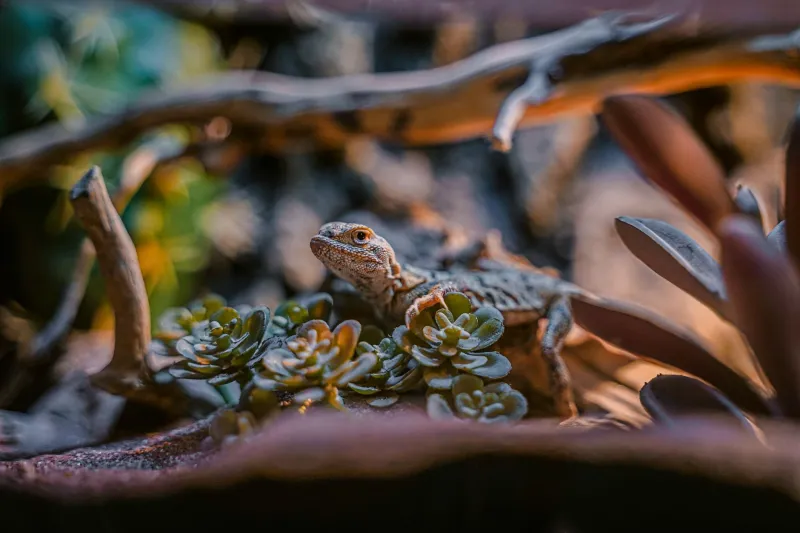
This has driven significant investment in what might be described as the architecture of exotic keeping. Bioactive vivariums designed by specialists who understand both horticulture and animal behavior. Custom climate control systems that replicate the precise temperature gradients and humidity cycles of a species' native range. Nutritional programs developed in consultation with exotic animal veterinarians. These are not merely functional investments — they are, for collectors who understand them, expressions of connoisseurship as sophisticated as any other form of luxury curation.
The financial implications are substantial. A properly appointed bioactive enclosure for a mid-sized reptile collection might represent an investment of $10,000 to $50,000 or more, exclusive of the animals themselves. Veterinary care from practitioners who specialize in exotic species — a growing but still limited professional category — commands fees that reflect both their expertise and its scarcity. The total cost of keeping exotic animals to the standard that serious younger collectors demand is, in many cases, considerably higher than the acquisition cost of the animals themselves.
Community as Currency
In perhaps the most culturally distinctive aspect of this generational shift, status within younger exotic collecting communities is determined less by the monetary value of one's holdings and more by the depth of one's demonstrated expertise and the quality of one's contributions to shared knowledge. The collector who breeds a genuinely significant morph and documents the process transparently — sharing genetic data, husbandry observations, and honest assessments of both successes and failures — earns a form of social capital that raw spending cannot replicate.
This is not to suggest that financial resources are irrelevant. They manifestly are not. But among the most respected figures in these communities, wealth is understood as a tool that enables serious keeping rather than as the primary qualification for it. The collector who deploys significant resources in the service of genuine expertise and responsible stewardship occupies a different — and, within these communities, higher — position than one who simply acquires expensive animals without the knowledge to properly care for them.
What This Means for the Market
The practical implications of these shifting values are already reshaping the exotic animal market in measurable ways. Demand for captive-bred specimens from documented, reputable bloodlines continues to outpace supply. Breeders who invest in genetic health screening, transparent record-keeping, and post-sale support are finding their waiting lists growing while less rigorous competitors struggle. The premium for ethical provenance is real and appears to be expanding.
For established institutions in the exotic collecting space, the message is clear: the next generation of serious collectors is not looking for the same things their predecessors sought. They are looking for partners in stewardship — sources they can trust, communities they can respect, and standards they can be proud to uphold.
At Onyxx Exotics, this is precisely the standard we have always aspired to embody. Rare. Refined. Extraordinary — in every dimension that word can possibly encompass. The collectors redefining this market are not departing from the tradition of genuine connoisseurship. They are, in many respects, its most rigorous practitioners yet.